Introduction
Launched in 2024, the Daara Development Academy is a co-created initiative designed to strengthen the capacity of African organizations to scale evidence-based solutions for foundational learning. An important component of this program was an Innovation Fund, intended to support collaborative projects between Daara partners that addresses sector needs to improve foundational learning outcomes. Projects could include the development of approaches, tools, and resources that align good practice within the Cohort with the science of teaching principles.
The project “Play-based learning: integrating narrative-based mathematics to improve numeracy outcomes” was awarded funding through this Fund and brought together three experienced African organizations: The consortium was led by The Action Foundation, which also led implementation efforts in Kenya. Rays of Hope led implementation activities in Malawi, while eBASE Africa was responsible for evaluation and evidence generation.
Case for follow-up and scale
Our innovative, low-cost, inclusive narrative-based numeracy approach has proven highly feasible, deeply acceptable to educators, and shown compelling early promise to improve numeracy learning in Kenya and Malawi. Education leaders in both nations are enthusiastic and eager to integrate it into national curricula, presenting a significant opportunity for transformative change. To build on this momentum and rigorously validate its impact on numeracy outcomes, a follow-up phase would solidify these gains and generate robust evidence for national numeracy strategies. Scaling this promising model involves expanding to more schools and students while embedding rigorous evaluation methodologies to definitively demonstrate impact and measure effect sizes.
Overview of the project
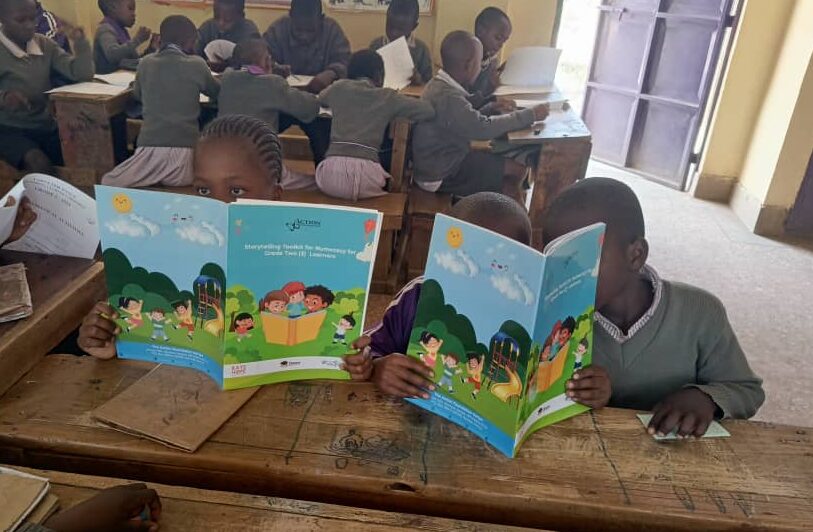
Foundational learning outcomes, especially in mathematics, in Kenya and Malawi present a significant challenge. Government data in Kenya indicates that less than half of Grade 2 and 3 learners achieve numeracy proficiency, particularly among children in informal settlements and those with disabilities. Traditional, lecture-based instructional methods have proven insufficient in fostering conceptual understanding or building learner confidence and engagement in mathematics. To address this, the consortium piloted narrative-based mathematics, utilizing storytelling as a pedagogical tool to transform math instruction. Teachers received training to integrate short, culturally relevant stories into lessons covering core numeracy concepts such as patterns, number sense, geometry, and arithmetic. Through structured workshops, coaching, and feedback sessions, storytelling served as a crucial scaffold, enhancing student engagement, mathematical reasoning, and critical thinking in the classroom.
Brief overview of the evaluation approach
The study employed a mixed-methods design to assess the executability of the intervention, improvements in teacher capacity, uptake and maintenance of evidence-based practices, and early indicators of student learning as a proof of concept. Conducted across 10 schools—8 intervention and 2 control—in Kenya and Malawi, the study involved 300 Grade 2 learners and 15 teachers. As part of a piloted experimental approach, one control school in each country served as a comparison arm to assess differences attributable to the intervention. The evaluation triangulated data from standardized learner assessments (EGMA in Malawi and WINGS in Kenya), a 29-item classroom audit checklist to track teacher compliance with evidence-based practices, and structured learner engagement surveys. Complementary qualitative data were gathered through key informant interviews, classroom observations, and focus group discussions with teachers to explore fidelity, contextual relevance, and instructional shifts. The intervention ran for four months in Kenya and six months in Malawi. Teachers participated in initial training and received ongoing support through structured feedback sessions—one in Kenya and two in Malawi—facilitating adaptive learning and implementation refinement.
Overview of the findings
The intervention demonstrated strong project executability across both contexts, with all intervention schools successfully delivering the storytelling-based numeracy lessons within the allocated timelines. Teacher participation was high, and implementation fidelity improved with structured feedback cycles, demonstrating acceptability of the intervention. The intervention was equally well received by decision makers. The Chief Education Officer for Blantyre, Malawi, reinforced this sentiment, stating, “I strongly believe this initiative should be expanded to all schools in the region because teachers truly need this kind of support.
There was a clear improvement in teacher capacity, particularly in instructional planning, formative assessment and direct explicit instruction. In Malawi, teacher compliance with evidence-based practices rose from 50% at baseline to 92% at endline; in Kenya, it increased from 69% to 85%. Teachers reported greater confidence in delivering content and adapting stories to learner needs. These improvements translated into sustained behaviour change, even in the absence of external support. Teachers consistently applied key elements of the intervention—storytelling, formative assessment, and learner-centered questioning—after initial training. In Malawi, teachers exposed to two rounds of feedback maintained higher levels of compliance, suggesting that even short-term coaching can anchor behavior change. One teacher in Malawi remarked, “I feel more creative when I create my own stories… I will continue using stories even after the project ends, I love the approach”. In Kenya, a teacher noted, “I used to struggle to teach patterns, but with the stories, it’s very easy”.
Learner engagement significantly increased, especially in Malawi where consistent participation rose from 25% to 82%. In Kenya, the increase was from 26% to 65%—while control groups remained below 37% in both contexts. Teachers equally highlighted increased motivation: “My learners are very excited about stories… even my slow learners are interested”, and “[s]tories have increased attendance; learners want to come and listen”. Learner performance also improved. In Kenya, learners below expectations in pattern recognition fell from 47% to 8%, while in Malawi, the percentage of learners struggling with number discrimination dropped from 37% to 0%. Gains in addition skills in Malawi were especially strong, with a 49-point improvement. These changes were not observed in control schools.
Read the full report Here
 English
  French